Tuesday, September 25, 2007

Philippine Towns and Cities: Reflections of the Past, Lessons for the Future

Join us at "Philippine Towns and Cities: Reflections of the Past, Lessons for the Future" on November 9, 2007 at the Sarabia Manor Hotel and Convention Center, 101 General Luna Street, Iloilo City.The main objective of this seminar series is to enhance civic engagement with local governments units so the Heritage Conservation Society (HCS) can inform and guide them on the proper care and utilization of a valuable asset — built heritage resources. The first seminar was held last 8 November 2006, at the Development Academy of the Philippines, Pasig City.In our towns and cities, wanton real estate speculation and over-construction are often mistaken for modernization when in fact these exert devastating pressure on the historic and cultural core of many of our human settlements. As a result, a valuable economic resource – built heritage — is left to deteriorate or is thoughtlessly demolished in the name of progress. Concerted effort is imperative to protect heritage resources because these are revenue and job-generating assets that can spark economic revitalization, as the case of Vigan clearly shows.However, there is a general lack of awareness at the local government level, which is precisely where policies should be formulated and ordinances passed to declare heritage districts and protect these as the town's or city's prime assets. Built heritage resources should be the core of any master plan for urban development and inner town/city revitalization. Livelihood opportunities are generated by adaptive re-use, the revival of traditional crafts for restoration work and an increase in tourism receipts.Significantly, communities begin to feel a "pride of place".The "Philippine Towns and Cities" seminar series is a communications campaign to influence policy makers at the local government level. Through the "Mayors' Forum", best practices are shared. Other stakeholders in the Executive branch, the private sector and the academe are invited to participate because heritage conservation is a multi-disciplinary concern.In a second seminar, the Heritage Conservation Society will take this awareness and education campaign to the local governments of the Vizayas, where built heritage resources abound in the cities of Cebu, Bacolod, Iloilo, Dumaguete, Tagbilaran, and many others.For more information, contact Ms. Dorie Soriano (HCS): 521-2239, 522-2497, info@heritage.org.ph; or Ms. Len Diño (UPF): 895-1812, 896-1902, 890-2480, annalynn.upf@gmail.com.

Tuesday, September 11, 2007

The Churches of Pavia, Sta. Barbara and Cabatuan

Santa Monica Church,
PAVIA
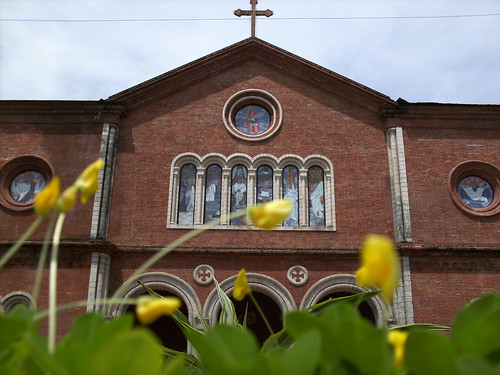
Finished in 1899, of red bricks and coral stone furnishing,the beautiful three nave church of Pavia was built through the advocation of Santa Monica. The overall design is purely of byzantine architecture. It is architecturally distinct since most churches in Iloilo are of Baroque or Neoclassic styles.
There is a copperative symmetrical movement on the facade brought by the complimenting effects of the rose windows and the arch entrances. The semi circular apse of the church completes its overall Romanesque design.

In World War II, like any other churches, Pavia Church served as a fortress protecting the people from the Japanese Army. before its restoration, bullet marks were still visible on its walls.
Santa Barbara Church and Convent,
SANTA BARBARA
Formerly called Catmon, Santa Barbara was made an independent parish in 1760 under the advocation of Santa Barbara Virgin y Martir. The present religious structure was built in 1855 and was finished in 1878.

Under the Tuscan Order, the facade is given a baroque drift by graceful broken arches and ornate finials crowning its facade. The three-storey affair of the facade is brought by an extravagant and excessive use of cornices and niches.
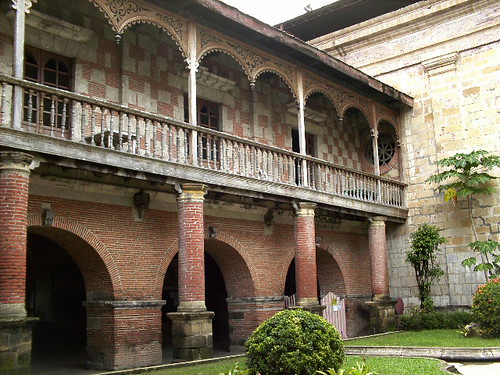
The convent of Santa Barbara is the cradle of Iloilo's Revolutionary government since it was made the headquarters of Gen. Martin Delgado, who struggled the odds to free Iloilo from the grasp of the Spaniards. It was successfully restored on the town's 220th anniversary. The convent is an example of Hispanic Moorish(Mudejar) architecture. A design commonly seen in Southern Spain. Today, both the church and the convent are declared as National Heritage Sites.
San Nicolas Tolentino Church,
CABATUAN
Cabatuan was a visita since the early 1600's. Formerly called Batuan, early Cabatuananons practice the Sinulog or the Dance of Death. It became an independent parish in 1732 and the present church was built in 1833 and was finished in 1866. It was noted to be the largest church in northern Iloilo. It was adored so much that El Eco de Panay described it as the 'Model of Temples'. It is the only church in Iloilo which has three facades. The Church which is Tuscanic in style imposes heaviness and massiveness. Its overall design is that of a majestic basilica, making it not any ordinary church. The Main facade is primarily decorated with Tuscan pilasters and ornate Agustinian symbols, while the eastern and the western facades remained in the Renaissance form. The structure is similar with Churches in Peru, wherein the twin dome belfries are almost as massive as the facade.

Saturday, September 08, 2007

Iloilo, Heritage Champion

By Augusto Villalon


ILOILO EVOKES MANY PLEASANT images, each one as soothing as its melodious language whose lilt perfectly sums up the local lifestyle and culture: laid-back Southern gentility graciously lived in a city on the banks of a river whose languorous flow sets the peaceful tone of the residents' pulse.

There is no other city in the Philippines with an image as distinct as Iloilo.


Once the center of the Visayan sugar industry, the city retains vestiges of that era. Muelle Loney, the city dock, commemorates Nicholas Loney, the Englishman who industrialized the sugar industry in the 19th century, exported sugar globally from Iloilo, and brought prosperity to the province.


There was another side to the entrepreneurial Loney who flooded the Iloilo market with cheap, machine-woven textiles imported from England, a move killing the flourishing Ilonggo hand-loom industry which was the source of the best hand-woven fabric in the Philippines.


Nevertheless, the face Iloilo presents today is still sugar-sweet. Elegant arcaded colonnades dating back to the Commonwealth era still shade city-center sidewalks, an urban amenity now vanished from other Philippine city centers in the name of development.


The Commonwealth-era buildings of Iloilo face extinction. The new malls have taken away retail activity from the old city center. There are plans to reuse the old downtown buildings to produce a heritage-destination setting that attracts the public and tourists away from the malls, a plan seen to revive the old city center and return luster to the city's tarnished pride of place.


Iloilo ilustrados


Descendants of illustrious Iloilo families continue to live in their stately homes that stand sometimes alone, at other times behind rows of commercial developments, on city streets that retain shabby remnants of its former grandeur.


Progress has swept away sidewalks, trees, and the small plazas that once made the city more livable than it is today.


Nevertheless, the city presents a wide range of architecture. Houses range from pre-20th century bahay na bato of the Spanish colonial era.


In Iloilo, the houses take on a Visayan character. They are more open and embellished than their Tagalog relatives. Superb mansions from the American colonial era, built in the 1920s in an eclectic style typical to Iloilo, remain.


Probably one of the best-preserved 1930s Art Deco houses in the country is aptly called Boat House, a reference to its flowing, streamlined lines recalling sleek ocean liners considered the height of modernity during that era, causing that particular variant of the Art Deco style to be called Moderne.


Iloilo unfolds on different levels. Some mansions struggle for existence side by side with unregulated commercial development on city streets. Fast-food stores in malls fail to capture faithful customers who still insist on going to the market, not a restaurant, for an authentic batchoy fix.


Ilonggo culture tempers 21st-century mass media and Internet culture with Visayan tradition, creating an interesting mix of cutting-edge technology and the old.


With its feet firmly planted on tradition is the Panaderia de Molo, an Iloilo icon deserving to be a national treasure. Its trademark striped tins of handmade cookies are prized gifts to any Filipino. Its bakery products are coveted Pinoy comfort food that maintain the old taste and texture no longer found in mass-manufactured products from commercial bakeries.


Established by the Jason sisters, ownership has passed to their Sanson great-granddaughters, the fourth generation of the family to manage the bakery. This generation zealously maintains original family recipes, still kneads and mixes by hand, uses traditional wooden and bamboo implements, and bakes in clay ovens fired by wood especially grown in the family's plantation.


Conservation body


Bent on preserving heritage, the Iloilo City Cultural Heritage and Conservation Council (ICCHCC) actively takes a hand in guiding the city to attaining a balance between tradition and the 21st century.


Enjoying support from City Mayor Jerry Treñas, who understands that the identity of Iloilo lies in its culture, well-connected ICCHCC board members are Iloilo movers involved in city government, civic organizations, mass media, business, professional and academic circles.


The ICCHCC is among the few organizations in the Philippines that have greatly increased heritage awareness. The organization successfully held a heritage awards program in 2005 that awarded the winners of a student essay competition and presented awards recognizing the best conservation and adaptive reuse of heritage architecture in the city.


Among its awardees were ancestral homes reused as schools, religious convents or restaurants, proof that heritage structures can be used for contemporary needs.


In May, the ICCHCC goes into full gear. Iloilo hosts the national culminating activity for Philippine Heritage Month on May 30-31 this year.


For the entire month of May the tireless


ICCHCC presents a series of activities celebrating heritage. A Flores de Mayo, exhibits of traditional culture, musical performances, lectures, and dance performances will be held in different venues all over the city.


The closing ceremonies in Iloilo City will be the highlight of the month-long celebration and focus on Panay cultural heritage, specifically Iloilo. During the two days, activities and events will include walking tours, park concerts, cultural performances, religious rites, and ceremonial receptions.


A good place to start an Iloilo visit would be at Museo Iloilo, whose exhibits introduce what the city is all about and whose director, Zaffy Ledesma, has an inside track on local history.


Walk next door from the Museo to the Department of Tourism Office (tel. 033-3375411) for detailed information on all cultural and tourism events sponsored either by the ICCHCC or the DOT which share an office in Iloilo City.


Source: Inquirer.net (
http://news.inq7.net/lifestyle/index.php?index=2&story_id=69948)

Feedback is welcome at afvillalon@hotmail.com