Join us at "Philippine Towns and Cities: Reflections of the Past, Lessons for the Future" on November 9, 2007 at the Sarabia Manor Hotel and Convention Center, 101 General Luna Street, Iloilo City.The main objective of this seminar series is to enhance civic engagement with local governments units so the Heritage Conservation Society (HCS) can inform and guide them on the proper care and utilization of a valuable asset — built heritage resources. The first seminar was held last 8 November 2006, at the Development Academy of the Philippines, Pasig City.In our towns and cities, wanton real estate speculation and over-construction are often mistaken for modernization when in fact these exert devastating pressure on the historic and cultural core of many of our human settlements. As a result, a valuable economic resource – built heritage — is left to deteriorate or is thoughtlessly demolished in the name of progress.

Tuesday, September 25, 2007

Tuesday, September 11, 2007
The Churches of Pavia, Sta. Barbara and Cabatuan
Santa Monica Church,
PAVIA
Finished in 1899, of red bricks and coral stone furnishing,the beautiful three nave church of Pavia was built through the advocation of Santa Monica. The overall design is purely of byzantine architecture. It is architecturally distinct since most churches in Iloilo are of Baroque or Neoclassic styles.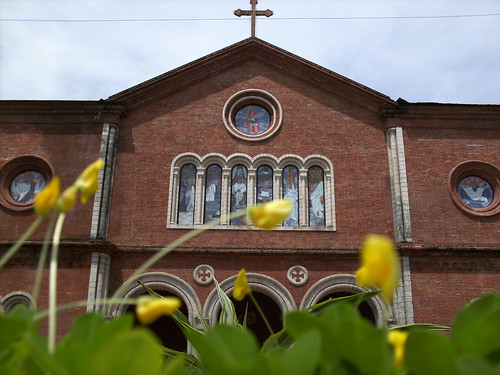
There is a copperative symmetrical movement on the facade brought by the complimenting effects of the rose windows and the arch entrances. The semi circular apse of the church completes its overall Romanesque design.
In World War II, like any other churches, Pavia Church served as a fortress protecting the people from the Japanese Army. before its restoration, bullet marks were still visible on its walls.
Santa Barbara Church and Convent,
SANTA BARBARA
Formerly called Catmon, Santa Barbara was made an independent parish in 1760 under the advocation of Santa Barbara Virgin y Martir. The present religious structure was built in 1855 and was finished in 1878.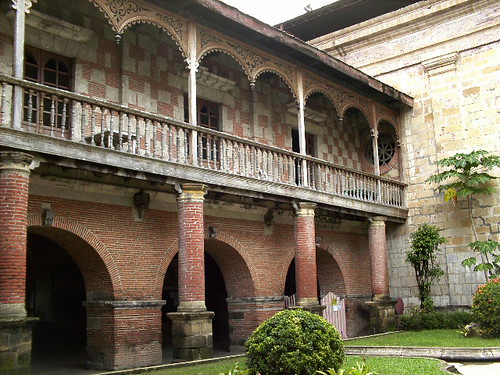
Saturday, September 08, 2007
Iloilo, Heritage Champion
By Augusto Villalon
ILOILO EVOKES MANY PLEASANT images, each one as soothing as its melodious language whose lilt perfectly sums up the local lifestyle and culture: laid-back Southern gentility graciously lived in a city on the banks of a river whose languorous flow sets the peaceful tone of the residents' pulse.
There is no other city in the Philippines with an image as distinct as Iloilo.
Once the center of the Visayan sugar industry, the city retains vestiges of that era. Muelle Loney, the city dock, commemorates Nicholas Loney, the Englishman who industrialized the sugar industry in the 19th century, exported sugar globally from Iloilo, and brought prosperity to the province.
There was another side to the entrepreneurial Loney who flooded the Iloilo market with cheap, machine-woven textiles imported from England, a move killing the flourishing Ilonggo hand-loom industry which was the source of the best hand-woven fabric in the Philippines.
ILOILO EVOKES MANY PLEASANT images, each one as soothing as its melodious language whose lilt perfectly sums up the local lifestyle and culture: laid-back Southern gentility graciously lived in a city on the banks of a river whose languorous flow sets the peaceful tone of the residents' pulse.
There is no other city in the Philippines with an image as distinct as Iloilo.
Once the center of the Visayan sugar industry, the city retains vestiges of that era. Muelle Loney, the city dock, commemorates Nicholas Loney, the Englishman who industrialized the sugar industry in the 19th century, exported sugar globally from Iloilo, and brought prosperity to the province.
There was another side to the entrepreneurial Loney who flooded the Iloilo market with cheap, machine-woven textiles imported from England, a move killing the flourishing Ilonggo hand-loom industry which was the source of the best hand-woven fabric in the Philippines.
Tuesday, September 04, 2007
Plaza Libertad [Iloilo City]
 During the Spanish colonial era, the most basic feature of a town was the square or plaza as the center of activities, may it be civilian or religious in nature. This is one of the Spaniard's policies in order to organize, evangelize and subjugate the natives under their authority. Called reduccion, it is the systematic resettlement of once scattered natives to town centers.
Plaza Libertad is the plaza for La Punta de Iloilo. Formerly known as Plaza Alfonso XII, it is surrounded by the Iglesia de San Jose de Placer (Church of Saint Joseph), the ancestral house of the Lacsons and the ruins of their botica (pharmacy), the city hall, Hotel Iloilo (now Landbank) and the Masonic Temple Building (which is at exact opposite of the church).
What made this historical was it was here that Ilonggos witnessed the surrender of the Spanish colonial troops, led by Governor General del Rios, to the Ilonggo revolutionaries on Christmas Day 1898. Iloilo was made the last capital of Spain in the Philippines after their defeat in Manila in August 1898.
Thursday, August 30, 2007
The Fall of Muelle Loney

Forgive my poetic license and for being so overly-romantic with history, I was the one who made that phrase but very comparable to this scenario in the 50's:
According to Alfred McCoy's work "The Queen Dies Slowly"*, it refers to the period when Iloilo's River Wharf (back then Iloilo's port only refers to the river wharf known as Muelle Loney) was under the conflict of two labour unions (more likely stevedores or arrastres: the Consolidated Union of the Philippines (CLUP) and the Federacion Obreros de Filipinas (FOF)) in order to seize control of the port.
After the opening of the port to international trade in 1855 onwards before World War II, Iloilo's wharf was really raking money, thus the famous slogan: "Ang Kwarta, ginapiko kag ginapala." ushered. Many people would want to control this lucrative infrastructure back then because the flow of money from sugar was immense. All sugar products from the vast planations in Negros Occidental are exported internationally through Iloilo City before World War II. The wharf was renamed "Muelle Loney" in remembrance of the British Vice-Consul who ushered in the era of sugar boom by introducing modern farming techniques and enocuraging sugar trade in Negros and Panay. Egro, he is known as "The Father of Philippine Sugar Industry"
After the Japanese Occupation, Iloilo's prominence in the Visayas and Mindanao was already waning because of the opening of a direct access of sugar factories to ports in Negros Occidental in Pulupandan and Bacolod. Also, since the sugar economy was already declining after World War II, many workers complained about their minimal wages, lay-offs and mismanagement.
The conflict between the two labor unions reached to the point where the Caltex Depot was bombed by mid-50's. Iloilo port's infamy reached the shores of Manila and Cebu and it discouraged the entrepreneurs and invstors to open up business in Iloilo. Passengers who are coming from different parts of the country feared of the port since not only these arrastres are rumored to do extortion to shipping companies and businessmen, but also pickpockets. The merchants fled the dying city. Thus, the "Death of the Queen" was inevitable.
That is how important an infrastructure is to a city. Partly what brought life to the city also brought death upon it.
The wharf has witnessed the the abandonment of her sons and daughters for better opportunities outside Iloilo back then. This was one of the reason of Iloilo's demise. A victim of monocrop agricultural industry and as what Ambeth Ocampo said "Prosperity without progress".
A bitter medicine that is hard to swallow and a lesson learned the hard way. But nevertheless, hope was never lost in every Ilonggo spirit. And now, they are moving forward, despite the recent adversities that hit the Ilonggo heartland.
*Alfred McCoy, A Queen Dies Slowly: The Rise and Fall of Iloilo City. The Philippine Social History (7). Asian Studies Association of Australia: South East Publicaion Series, pp.297-358.
Subscribe to:
Posts (Atom)